Education · 2022
HEIP 1 - Supported and Funded by World Bank under the Supevision of DHE, Cambodia
The Accounting Program Improvement Initiative, funded by the World Bank under the Higher Education Improvement Project (HEIP), modernizes our university's accounting curriculum and strengthens teaching capacity through strategic international collaboration with Yeungnam University, South Korea.
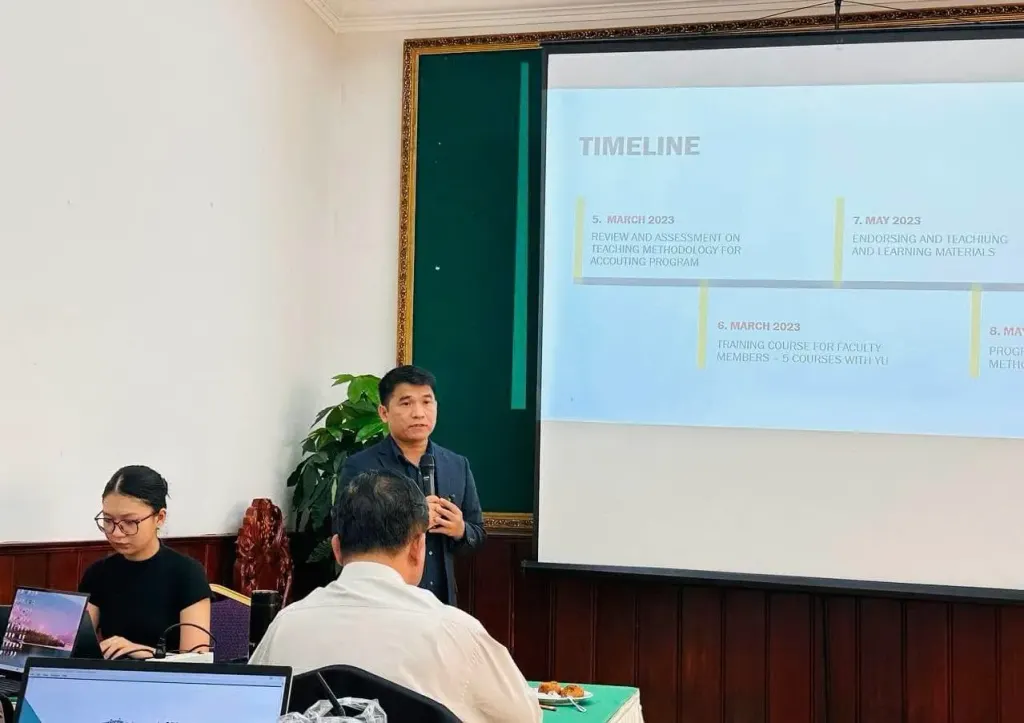
Description
Supported by the World Bank through the Higher Education Improvement Project (HEIP), this initiative upgraded the university’s undergraduate Accounting program to meet international academic and professional standards. Led by an experienced team of accounting faculty alongside a lead expert trainer from Yeungnam University (South Korea), the project restructured core course curricula, introduced contemporary pedagogical methods, and conducted comprehensive faculty development to ensure graduates are thoroughly prepared for the evolving regional financial sector.
Objectives
Curriculum Modernization: Update and align the undergraduate accounting curriculum with international standards and regional financial market demands.
Faculty Capacity Building: Enhance instructional skills and pedagogical approaches through specialized training and knowledge transfer led by experts from Yeungnam University.
Employability & Practical Relevance: Integrate contemporary accounting practices, digital competencies, and applied problem-solving to strengthen graduate career readiness.
Institutional Benchmarking & Quality Assurance: Establish robust academic and assessment standards supported by the World Bank's Higher Education Improvement Project (HEIP) framework.
Global Academic Collaboration: Foster enduring cross-border partnership and academic exchange between Cambodia and South Korea.
Methodology
To systematically upgrade the Accounting curriculum and align it with international educational standards, the project employed a multi-phased collaborative approach:Curriculum Benchmarking & Needs Assessment: Evaluated existing accounting course syllabi against regional accreditation frameworks and current financial sector requirements in Cambodia. Cross-Border Faculty Capacity Building: Conducted specialized online seminars and Training-of-Trainers (ToT) workshops led by international subject-matter experts from Yeungnam University (South Korea), focusing on advanced accounting and taxation pedagogy. Instructional Material Redesign: Systematically revised course materials, textbooks, practical problem sets, and modern teaching aids across core accounting modules. Constructive Alignment of Learning Outcomes: Redesigned course syllabi to incorporate measurable student learning outcomes (SLOs) and standardized assessment matrices.
Findings
Curriculum Modernization: Successfully updated the undergraduate accounting program, integrating practical industry skills, contemporary financial principles, and digital accounting competencies. Strengthened Instructional Quality: Participating faculty members developed enhanced pedagogical tools and modern instructional strategies for teaching complex accounting and taxation topics. Enhanced Learning Resources: Developed standardized course syllabi, lecture decks, and applied learning materials for departmental continuity and accreditation readiness. Sustainable Institutional Partnership: Established an active cross-border academic exchange model with Yeungnam University to support continuous curriculum enhancement.